I first met Ava Bergen in the cafeteria of our small Christian liberal arts college in Western New York state. It was the start of our sophomore year, that season when everything feels fresh and full of potential, and before the college-provided meals taste stale and overcooked. I was a new transfer student from Canada, and Ava and her friends immediately took me under their wing as a fellow English and Writing major. Over three years, we grew closer through creative projects: creating short films, co-editing our undergraduate literary journal, and auditioning for plays. My favorite memories with Ava occur anytime we left campus, whether we were filming, taking pictures, or just exploring the stark wilderness that surrounded our campus. There wasn’t much to do in our one-road college town, but we were never bored. Or, if we were, we knew what to do with that boredom.
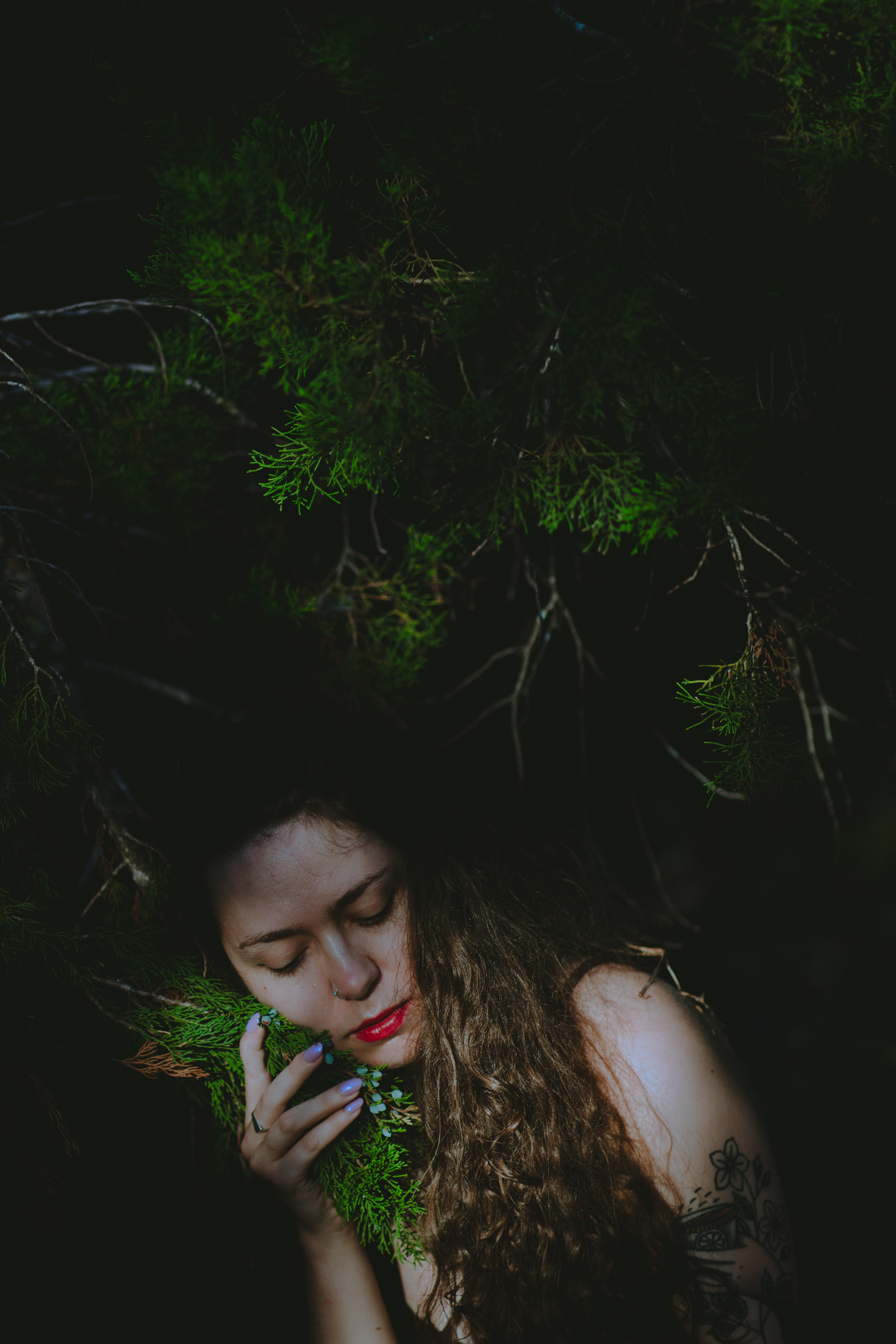
Flash forward almost twelve years since our first meeting, and while we’re in very different places (I live in a Canadian city where spring doesn’t hit until mid-April, she’s in sunny central Florida), we both continue to center creativity in our lives. Over the last five years, Ava has thrown herself headfirst into the world of photography, creating dreamlike pieces that evoke the weird and the wonderful. Our issue two cover, from her series “Divine Feminine” featuring model Ixchel Vásquez-Castañeda, beautifully captures Ava’s surreal visual style, all created with painstaking care. I was thrilled to catch up with Ava over video call this past month and discuss how she’s arrived at this place in her art, how she has overcome fallow periods as an artist, and what it means to set the table for creativity.
Sophia Ross Eckert: Because I know you personally, I know you’ve been creative throughout your life, so I would love to hear about when you feel your journey as an artist began. Did you always know you were an artist, or did that develop later?
Ava Bergen: I grew up with creatives in my house, in a very neurodivergent household. It was very chaotic and emotionally turbulent, but also very loving. My brother is an artist, and he’s an artist who fits my cultural and socioeconomic surroundings’ concept of an artist. He drew things that looked like the things he was drawing, so people could recognize that as art. And he was very, very good. He’s incredible, in fact. And I…I did a bunch of random shit. Something I’ve been grappling with lately is that, yes, I’ve been creative, but I’ve never given myself permission to be an artist or call myself an artist until very recently, probably about two years ago. I was always more artist adjacent. I loved the creative process so much that I wanted to be around it, but I didn’t give myself permission to be part of that as an artist. I was a writer, and I made things. I collaged, I did crafts, but in my head, I wasn’t connecting that that was also art. Being an artist – I thought that had its own rules. Weirdly, I’ve always been drawn to photography, ever since I was little, but like, I didn’t think that was art.
SRE: What did you think it was?
AB: That was just taking pictures of my friends. I didn’t think of it as making art. Does that make sense so far?
SRE: Totally. You’re a great writer, and I can see how that would have felt like an easier path to follow at that time if you didn’t think of yourself as a visual artist yet.
AB: It felt like I needed to validate my existence in some way, and to prove that I was something. And so, I became a writer, because I had to validate my existence, because obviously I couldn’t possibly have merit on my own, just existing. I had to do something and be someone, and all of the things that artists and writers think they have to do to prove themselves.
So, I followed the path of writing, which I do love, and I love reading, but looking back, I was obsessive about photography. Obsessive. But it was like, let me take pictures of my friends when we’re hanging out. Let me spend hours editing in Picasa, which is a really, really shitty photo app that makes your photos look cheesy, and well, then again, what is art? Is that art? I am inclined to think that it is. But at the time, I was not an artist because, and this has stayed with me my whole life, I had an art teacher tell me – I was in sixth grade. I still remember it. We were doing this project that required tidiness and organization and learning perspective, which I still struggle with, and she said, almost to herself, just in my vicinity, “Man, it’s such a shame. You might be good if you weren’t so disorganized.”
SRE: Oh my God.
AB: And I…that stayed with me my whole life. It didn’t matter that other people, like my mom, who’s also an artist, told me that I’m naturally good at these things. I had people tell me I could do this along the way, like little sprinkles of fairy dust, but none of the fairy dust sprinkling was as impactful as the absolute crushing weight of that one sentence that that one art teacher told me. I’m sure she doesn’t even remember saying it.
SRE: No, but I think that’s a pretty universal experience for artists of all kinds, where the person who is an “authority” says something about your work, whether it’s a negative or a positive, and it can define who you think you are as an artist if you let it.
AB: Right. Having an art teacher who says they know the rules, like, the rules of art, is such an oxymoron to me. As an artist, you’re limited by any rules that you impose on yourself, by even calling something a painting, and saying, “a painting is something you put in a frame,” that’s a limitation in and of itself.
I agree with what you’re saying. I’m sure you can think of, off the top of your head, five teachers who said something shitty that has impacted your work.
SRE: Oh, for sure. That’s the trick – you have to learn how to keep doing it anyway, which I know that you did, because when I met you in 2014 my initial impression of you was as a creative person. Like, you dressed very cool and creatively, and I remember meeting you and thinking you knew yourself. You were taking writing classes with me, but you were also a communications major, right?
AB: Yes. Which is also funny, as a recently diagnosed neurodivergent and ADHD person, that I would gravitate towards communication, like, literally learning how to communicate.
SRE: And part of that major was more learning about organizational communication and communication structures, but you were also taking advantage of the mixed media classes. When did that start to enter your life?
AB: Man, I’m really grateful for that, because I was too scared to take what I really wanted to take, which was photography classes. I was too scared, because I didn’t even understand what I wanted in any way, being young. I think I was forced to take one of those [media classes] to get all my credits, and I was so fucking terrified. That was the first breaking of the ice to what I truly wanted to do. I see, in retrospect, all the slow ways my life was trying to teach me something new that I really did not want to do, even though I did desperately wanted to do it. Equating my value to my output, my productive output, whatever the fuck that means. My value was equated to what I could produce, or what others thought, and like a lot of neurodivergent people, I think I distrusted my own intuition, because I’d been told over and over that whatever you think is the right thing to do is probably wrong. That’s mostly what the feedback had been.
SRE: Knowing you at that time, I never would have suspected you felt that way. I knew your written work, your fiction and your poetry, and I loved that, but I also loved your photography. I remember, if we were going out, you would take photos, and that was fun for me as your friend, because I was like, oh, I’m going to have a good photo of myself since Ava’s here.
AB: Oh my gosh, and that was fun for me, because I was able to engage with the world around me in a way that I liked. Like, I had a role.
SRE: Very early on after we met, you started taking filmmaking classes, and then you were making these cool videos. And I was so honored when you asked me to be part of two of them.
AB: That was really, really fun. I was so grateful that you wanted to participate and be part of that with me.
SRE: What were those classes like?
AB: Some of the assignments, I was just trying to get through, like, just to get it done. And some of it, like, that was probably the first time when I had to do something creative. A lot of my creative work before, I didn’t have to do. That was the first time I fought through the pressure, and that ended up being a really good experience. What surprised me about it was even though I would start with this pressure, it would take a completely different turn that I wasn’t expecting and grow with the vision as it was evolving. And you have to evolve, because the people who are involved influence it. So, like with you in that first short film, we had to change the story, because it just naturally changed as we were shooting it. That was a really cool, unexpected part of the process.
SRE: Yeah, I remember making that first film, it was you, me, Thomas, and [our friend] Elyse in the woods, and it was so fun. Then we repeated that a year later, just you, me, and Elyse. That was the three of us going into fields and the woods…
AB: Literally trespassing.
SRE: For sure.
AB: Being creepy in the woods.
SRE: The story with that one changed, too. Feel free to correct me if I’m wrong, but my memory is that you came back from fall break, and you’d gotten some footage at a friend’s house in New Hampshire that you wanted to turn into something longer. That project was for a higher-level class, and you had the intention of showing it at our school’s film festival in the spring, so I feel like we took that project more seriously. What was that process like for you? It was a few months of our life.
AB: It really was! Oh my God. Compared to what I do now, making films seems a lot harder actually, because I have more creative control now. Now, I feel confident enough in my editing abilities that if I get a bad shot, I feel confident enough that I can fix it, right? Or I can edit it in a way that it becomes a different piece, even if it’s not what I intended.
Film is not like that. You have to plan everything out, what the shot’s going to be, and to get that one little shot requires all these hours of planning, all this preparation, and the fact we did that with just three people is crazy to me now. Like, I googled, “how do you make fake blood” and made the grossest shit I’ve ever smelled in my life, just on my little stovetop in my dorm. I’ve been listening to this audiobook – I’m not going to remember the name – but he’s talking about how the beginner’s mind is an amazing place, because you don’t know what you don’t know, and you don’t know that you’re not supposed to be able to do something. Like, I feel like that film we shouldn’t have been able to do, because it was insane. And I’m proud of it. I think it’s a cool thing we made, and it took months. But, like, the idea that you would spend months making something that’s three minutes long…I think that’s a really sacred creative expression that I wouldn’t trade for anything, you know?
SRE: Me neither. That’s one of my favorite memories from college. There was so much else going on, we were on this very small campus, and filming that project, we got out into the world for a few months and found all these out-of-the-way places in Allegany County.
AB: I think about Allegany County now, and I’m like, oh, I want to go back! I want to take pictures at all those houses!
SRE: That’s my main memory of being creative with you in college, but I’m sure there were other things going on. Was there anything else you remember from college that you think about now in your artist practice?
AB: It’s interesting, even with those shining moments, I think back then, I was just waiting for someone to call me an impostor at any moment. I was waiting for them to say that I was faking it. Maybe that doesn’t make sense for people who don’t have impostor syndrome, but I don’t even know how to explain it. It’s like I was barely an artist. Anything I did create, I felt like it was by accident. If I had a good idea, I was like, oh well, I don’t have anything to do with that.
But now, I know it’s not by accident, it’s about creating the mindset for ideas to occur, and for art to be made. I feel like, as artists, we’re setting the table to channel something. Back then, instead of understanding that I’ve set the table to allow this thing, I thought, oh well, I guess the muses didn’t have anyone else to talk to today because they picked fucking me. It took a mindset shift for me to understand it.
Also, we don’t have to go too deep into this, but I had this capitalist culture mindset that, oh yeah, Ava’s making her videos, but that’s not going to make any money, so therefore, it doesn’t have value. I let myself do those mixed media classes because it was in pursuit of a degree that would “make money.” I was taught that that was what had value. I could love writing, I could love making art, but I had to find something that made money. All that to say, my forays into creativity in college were my happiest times, but I wasn’t able to recognize why they were the happiest.
SRE: That’s surprising to me, but I totally get it.
AB: I wasn’t seeing the value in the creative process itself, even though that was the Holy Grail. For any artist, I think the Holy Grail is being lost in the process of art, and that’s what we chase is that flow state. That’s where I feel the happiest and the most connected to the world, but I was only seeing through the lens of what was going to be respected by society at large. Everything else was secondary to that.
SRE: That makes a lot of sense. We were also in a pretty conservative space at the time. We were in this Christian space in college, and even though I feel like the professors are the people who kept me feeling like I could be expressive, and I didn’t have to conform entirely to the evangelical culture around me, it was still there. It was…
AB: Pervasive.
SRE: Oh, yeah, we were surrounded by purity culture all the time. We were surrounded by a lot of people who were happy about the 2016 election. We graduated in 2017, and that was a really stressful time to be going out into the world in the United States.
AB: And people were pumped, man. That was a very dissonant moment, because you don’t think about the water that’s around you when you’re a fish, you just don’t think about it.
SRE: Yeah, and I think there was a real feeling that our school, in terms of Christian colleges, was more progressive. It didn’t really occur to me until the election, and until I started talking to people who were being disenfranchised by the school that, oh, this is not a safe place for everyone. But on the flip side, it was sometimes a safer place for people than a more conservative college, or even their home might be.
AB: If some of the more progressive professors weren’t there, I don’t think I would have stayed. Or if I hadn’t met you and our friends, I just wouldn’t have stayed.
SRE: Right. When people ask if I regret it, I always say no, because the people I met there, a lot of the faculty and students, are the reason I am who I am now. I wouldn’t want it any other way.
AB: It’s a very important part of our stories, you know?
SRE: So, we graduated in 2017, which, again, a stressful time to be going out into the world, especially as a young woman, I think. But you mentioned, you’re thinking at that point about making money after college. Obviously, I was, too. But what does that mean for your creativity? What happens with your art?
AB: Oh, it totally dies. Well, okay, that’s the thing, it never dies. You can’t kill something like that, thank God. But it can go…it can go fallow. Dormant. Whenever I’m in a fallow period, I just latch on to the creative people around me, and I vicariously live through them, and I live very enviously. I think I kind of just…followed. I didn’t really know where to go, or what to do at all. I was focused on making money and getting a job, but they were all art adjacent jobs, ones that I felt like I was allowed to have. I worked at a restaurant for an entire year, and it was great, but it was also a very hard time.
I didn’t know what to do with myself. At that point, school has been my whole world, and I can’t get any of these jobs that I’m allowed to have. I can’t get marketing jobs, I can’t get these other jobs, so I guess I’ll work at a restaurant. One of the people there was a photographer, and I was obsessed with his art. I was always asking him questions, like, how are you doing art while also working, how are you doing this? And, like, how did you start doing this? Looking back, obviously I wanted to do something similar. Once, we went to take pictures together, and it’s still a highlight of my time at that job, because I was out shooting.
I always felt like I needed permission from people to make art, and I don’t need anyone’s permission, except for my own permission. It probably sounds weird to someone who hasn’t been inside that before, like, why would I need someone else’s permission to do what I love to do? But nobody taught us – and I don’t know why, because this is the most important thing I’ve learned in my entire life – nobody can make something like you can. Nobody can do that, and if you don’t do it, well, it’s not going to get made. Shit. You better make it!
SRE: Absolutely!
AB: It doesn’t have to be anything, it just is what it is. Isn’t that crazy? We have these overriding stories about ourselves that are so limiting.
SRE: Fast-forwarding a little, we didn’t really keep in close touch after graduation. But then the pandemic happens, and you start posting on Instagram again. And for me, I was so excited. I remember thinking, Ava’s back! How did you get to that moment where you’re posting your work on the internet again?
AB: So…years go by. I’m a high-masking, ADHD adult who doesn’t know that she is neurodivergent, and just thinks everyone else can do life, and I can’t do life the way other people do because I’m exhausted all the time. I can’t seem to eat or keep my apartment clean. I’m working 60 hours a week because my income is all that we have while my husband is in law school. I ended up getting a job where I’m finally “making money.” I have what I wanted, which was a job. And I feel validated in that. So, of course, I do the high achiever thing, which is I lose myself in my work, and I become a husk of myself.
I do think there was a lot of internal growth that had to happen, and we can skip a lot of that, but eventually I was confronted with the fact that I had everything I wanted…and I still wanted to kill myself. So, what’s that about? Part of that was being unmedicated, I think. As a sensitive soul in this world, there is no box for us. It just doesn’t exist, and so we don’t do well in a world where it wants us in boxes.
Anyways, a lot of stuff happens. I have this dream after reading a book by Dr. Clarissa Pinkola Estés, who’s a Jungian psychologist. I have this dream where I’m flailing around in this land of bones, and I’m in this crow woman’s hut. It’s all made of bones, there’s bones everywhere, and she says, “Why did you come visit me so soon?” And I say, “I think this is a trick question. You brought me here.” And she says, “You’re right, good one. I brought you here because this is where you live right now. You’re here too soon. You are so full of unrealized ideas that it’s killing you from the inside out.”
In Jungian archetype land, there’s a medicine woman who can sing over the bones, and they can become life again. So, I feel like it’s very symbolic that I was just in this land of bones and death, and that’s where I lived without making anything. I would make stuff by accident, of course, but that was just little scraps. I was in survival mode in my creative life. Talking with the crow woman, she’s just like, “If you don’t want to die, straight up” – she didn’t say straight up, she was much more ethereal than that – “If you don’t want to die, you better start creating again, or you are going to poison yourself and you are going to die.”
I woke up and I remembered all of it, because I think I actually talked to some entity. Someone came to visit me, the crow lady came to visit me, and I better take that shit seriously. And so, that same day, I started taking self-portraits again, which is what I…you know how you just get these creepy-crawly ideas that tickle your brain, and you think, if I had the time, I’d do that, or if I didn’t suck, I’d do that? Which…why do we tell ourselves these things? But I started just the act of doing. I had to learn the act of doing just a little bit every day, and I was doing it not to die.
It became something I could do to thrive, because it didn’t matter…it didn’t matter what the end result was. What mattered was that I was doing it at all. I was setting the table for creativity to show up.
SRE: That is very intense, and it feels like…I mean, for me it’s never gotten quite to that point, but I have gotten to the point where I feel like it’s hard for me to exist and not do the thing I think I’m here to do.
AB: Yes, we all have that. I think I was particularly dense and needed someone to come and whack me up inside the head. Literally, someone was just like, okay, she’s not getting it. Let’s just hit her on the head. But we all feel that, though. All artists know what that is.
SRE: Yeah, we do. Well, you have this revelation, and then you start your self-portrait series.
AB: The deal that I made with myself was that I would just do something every day. Sometimes I’ll have more energy, sometimes I won’t. But as long as I just do something, then it counts.
SRE: I remember you started posting the self-portraits. Was Instagram an accountability thing for you? Like, I’m going to make something and then I’m going to share it?
AB: Exactly. I decided I have to share it, even if it sucks.
SRE: What was the response initially?
AB: There were some people who knew me who were like, oh, Ava’s alive! I was like, I am! Besides that, I tried to not pay a lot of attention to it, because if I found myself appreciating feedback, I would get hung up on it. I tried to ignore it for the most part. I had to let myself do different things without feedback, because if you become known for something, it can be really easy to get stuck in that box.
SRE: That sounds like the right instinct, especially that early into coming back to your practice. Eventually, you start working with models and other photographers. How did that start?
AB: I reached out to models on Instagram, genuinely, and asked if they wanted to shoot. I offered them pictures in exchange for them modeling. It cost me money; I paid for the studio rentals. My first time, I was so scared that I almost turned around and went home. Eventually, I found people who knew people, but mostly I was hitting up people on Instagram, which I don’t know if that’s very sexy or cool, but I would just ask, hey, do you want to meet? I’ll take your picture.
I stayed in that mode, and I miss it sometimes, for about a year. What’s special about it is that it’s what I wanted. I wasn’t taking photographs for a portfolio or for someone else – I wanted it because I wanted to have that experience, and that’s why I did it.
Since moving to Florida, I have to start over. I know that I will find my people, I always end up finding my people, but at first there’s just a lot of not finding my people.
SRE: Yeah, there’s a lot of people out there.
AB: And what’s beautiful about that is…it’s nothing about me. It’s nothing about them; it’s about finding people that inspire me to create. And that I hopefully inspire them, too.
SRE: What are your dreams for your work going forward?
AB: It’s funny, I have a lot of dreams about being somebody, and I don’t even really know what that means. But I think my most pure dream is to just keep making and having the opportunity to make. All the time. And to never lose that. I feel like I’ve been in a really fallow period right now – moving to a new state, moving into a new house, and then another new house, it’s been so hard. My car broke down. I struggle with change at the best of times.
Right now, I want to get back to that beginner mindset. I want to be making because I love to do it without feeling like I have to. Going back to the off season itself, I also submitted my work to a bunch of places, and I got rejected, you know? And that kind of killed my spark for a while. It’s painful when that happens.
SRE: It is.
AB: It’s so painful, and I’m grateful for it because, going through that, I’m realizing that it doesn’t matter. The only thing that matters is that I decide every day to do something creative. That’s the only thing that matters. Everything else is going to become part of that, and it’s going to happen to me by accident, because when I was aligned with my inspiration and creativity, all of that stuff was like an afterthought. I’m trying to get back to that primal state of being with creativity.
You can check out Ava’s work on her website https://www.etherealphotography.art, and on Instagram @avatoast.
Sophia Ross Eckert is a prose writer and editor from Ontario, Canada. She holds an MFA in fiction from George Mason University, where she served as Editor-in-Chief for phoebe. Her fiction has been shortlisted in several literary contests, and her work has appeared or is forthcoming in Santa Clara Review, West Trade Review, and Salt Hill. She has been awarded residencies at the Vermont Studio Center and Banff Centre for the Arts. When she isn't at her desk reading or writing, her favorite place to be is in the woods with her dog, Winona, searching for the perfect stick.